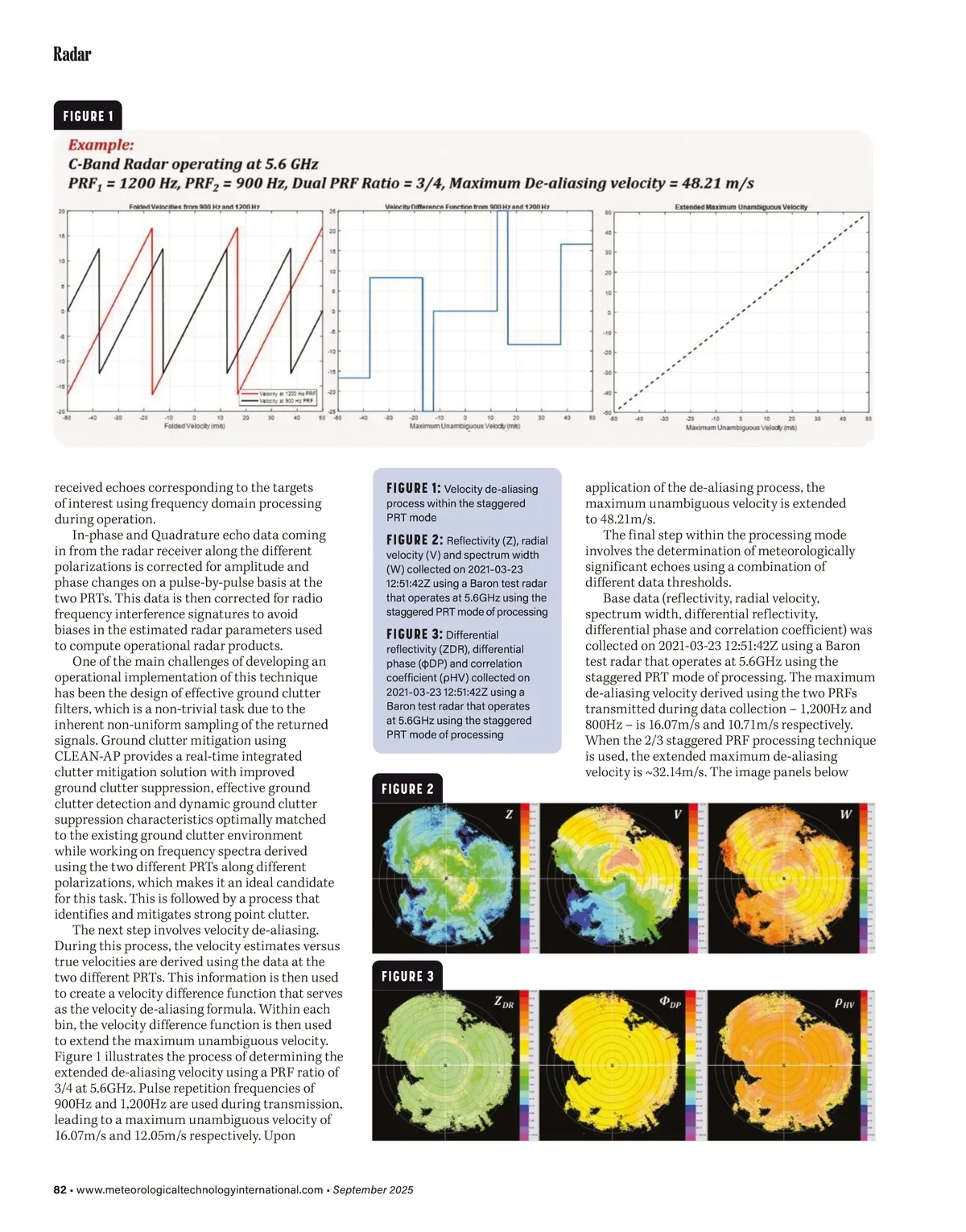
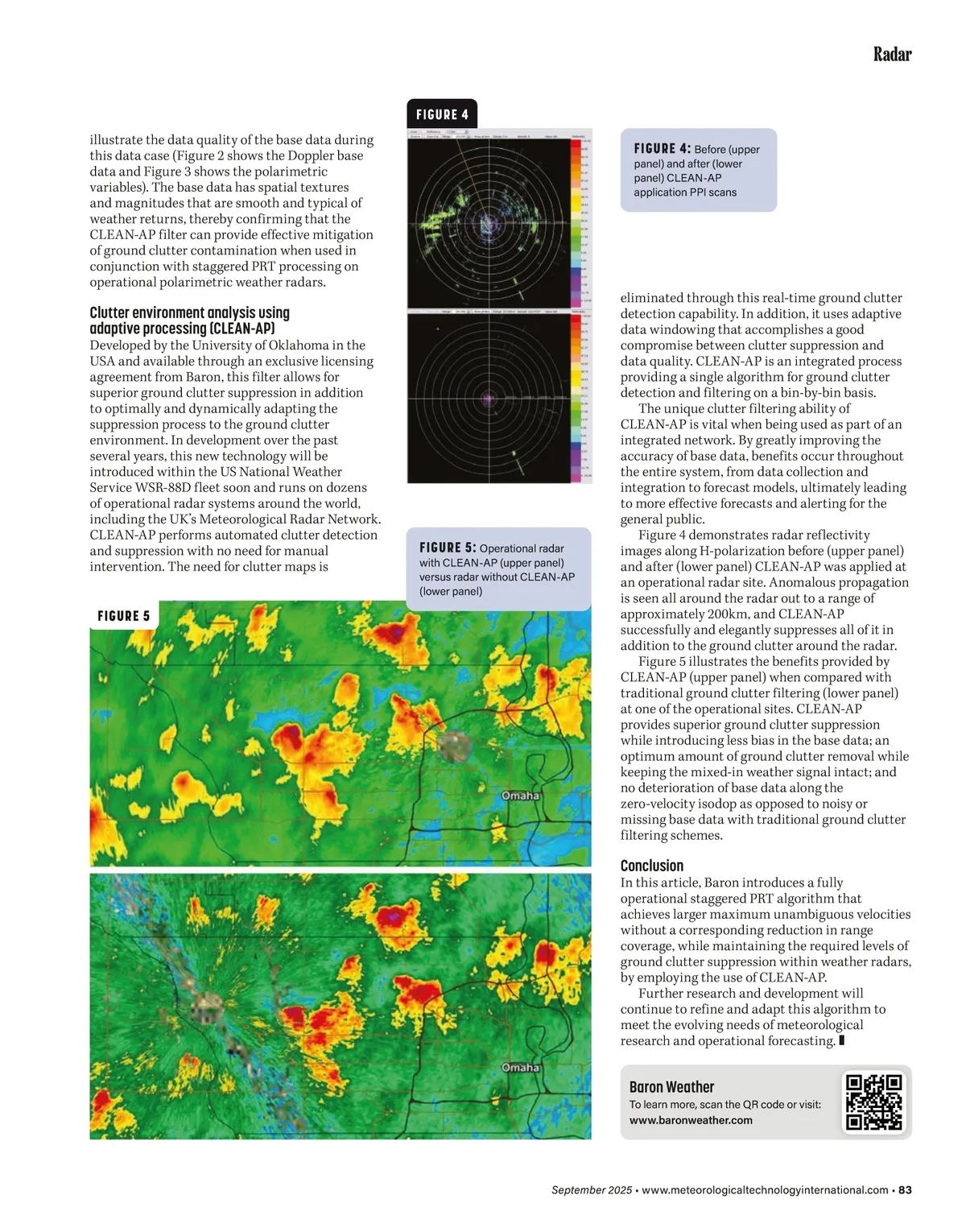
Radar FIGURE 1 received echoes corresponding to the targets of interest using frequency domain processing during operation. In-phase and Quadrature echo data coming in from the radar receiver along the different polarizations is corrected for amplitude and phase changes on a pulse-by-pulse basis at the two PRTs. This data is then corrected for radio frequency interference signatures to avoid biases in the estimated radar parameters used to compute operational radar products. One of the main challenges of developing an operational implementation of this technique has been the design of effective ground clutter filters, which is a non-trivial task due to the inherent non-uniform sampling of the returned signals. Ground clutter mitigation using CLEAN-AP provides a real-time integrated clutter mitigation solution with improved ground clutter suppression, effective ground clutter detection and dynamic ground clutter suppression characteristics optimally matched to the existing ground clutter environment while working on frequency spectra derived using the two different PRTs along different polarizations, which makes it an ideal candidate for this task. This is followed by a process that identifies and mitigates strong point clutter. The next step involves velocity de-aliasing. During this process, the velocity estimates versus true velocities are derived using the data at the two different PRTs. This information is then used to create a velocity difference function that serves as the velocity de-aliasing formula. Within each bin, the velocity difference function is then used to extend the maximum unambiguous velocity. Figure 1 illustrates the process of determining the extended de-aliasing velocity using a PRF ratio of 3/4 at 5.6GHz. Pulse repetition frequencies of 900Hz and 1,200Hz are used during transmission, leading to a maximum unambiguous velocity of 16.07m/s and 12.05m/s respectively. Upon FIGURE 1: Velocity de-aliasing process within the staggered PRT mode FIGURE 2: Reflectivity (Z), radial velocity (V) and spectrum width (W) collected on 2021-03-23 12:51:42Z using a Baron test radar that operates at 5.6GHz using the staggered PRT mode of processing FIGURE 3: Differential reflectivity (ZDR), differential phase ( φ DP) and correlation coefficient ( ρ HV) collected on 2021-03-23 12:51:42Z using a Baron test radar that operates at 5.6GHz using the staggered PRT mode of processing FIGURE 2 application of the de-aliasing process, the maximum unambiguous velocity is extended to 48.21m/s. The final step within the processing mode involves the determination of meteorologically significant echoes using a combination of different data thresholds. Base data (reflectivity, radial velocity, spectrum width, differential reflectivity, differential phase and correlation coefficient) was collected on 2021-03-23 12:51:42Z using a Baron test radar that operates at 5.6GHz using the staggered PRT mode of processing. The maximum de-aliasing velocity derived using the two PRFs transmitted during data collection – 1,200Hz and 800Hz – is 16.07m/s and 10.71m/s respectively. When the 2/3 staggered PRF processing technique is used, the extended maximum de-aliasing velocity is ~32.14m/s. The image panels below FIGURE 3 82 • www.meteorologicaltechnologyinternational.com • September 2025
Meteorological Technology International Meteorological Technology International September 2025 Issue: Page 82